
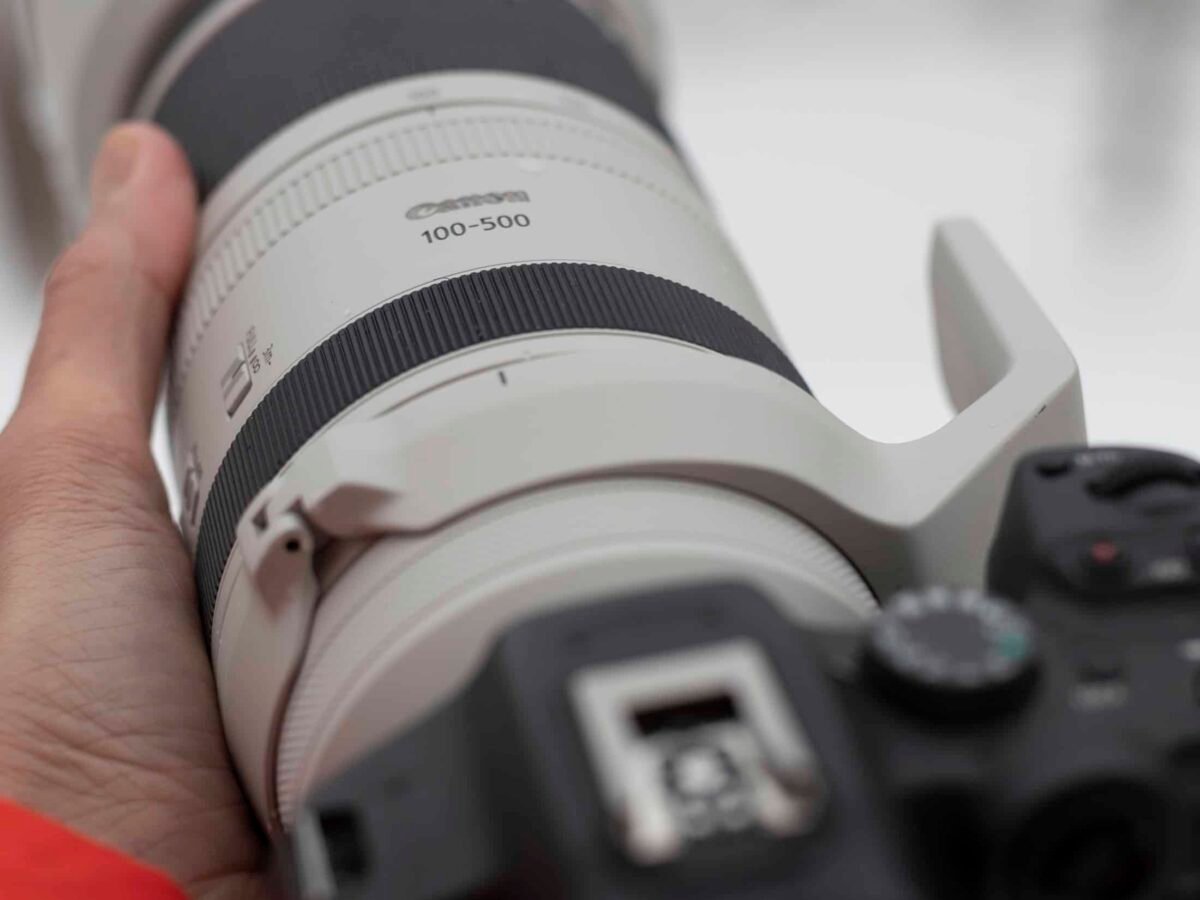
The Canon RF 100-500mm f/4.5–7.1L IS USM is a purpose-built telephoto zoom for photographers who demand reach, responsiveness, and reliability in uncontrolled environments while wanting the flexibility and ease of not carrying 2 or 3 different lenses. This lens is designed for efficiency. It delivers professional-level autofocus, strong optical performance, and practical handling in a focal range that directly serves bird, wildlife, and outdoor sports photography. Canon has managed to do this at a pretty reasonable price point as well. At the time of writing this review, the Canon RF 100-500 is coming in under $2,600 from B&H Photo, which is an amazing price for their “L” series glass. Canon engineered this lens for shooters how need a light flexible option that delivers consistent results without hauling oversized primes into the field.

The RF 100-500mm is designed for Canon’s full-frame (will work on a cropped sensor also) mirrorless RF mount. Its 100–500 mm focal range delivers exceptional reach for wildlife, sports, and action photography, while maintaining a relatively compact and lightweight form for such a long zoom range. The optical design uses 20 elements in 14 groups with one Super UD and six UD glass elements, which helps control chromatic aberration and deliver high sharpness across the zoom range. An Air Sphere Coating (ASC) further reduces flare and ghosting for clean contrast in challenging lighting. The lens also features an advanced image stabilization system that provides up to roughly 5 stops of shake correction on its own and up to 6 stops when paired with in-body stabilization on compatible EOS R cameras, making handheld shooting more reliable at long focal lengths.
Autofocus and handling are strong points of the RF 100-500mm as well. A pair of Dual Nano USM motors deliver fast, smooth, and near-silent focusing—beneficial for both stills and video—while the lens includes a customizable control ring and a rotation-type zoom ring with torque adjustment for precise and intuitive operation. Weather-sealed construction with fluorine coatings on front and rear elements protects against dust and moisture, making it capable in tough outdoor conditions. The lens also boasts a relatively close minimum focusing distance of 0.9 m (at 100 mm) and a maximum magnification of 0.33× at 500 mm, increasing its versatility for detailed subjects. Compatibility with optional RF 1.4x and 2x extenders expands its reach even further when needed. We did not test this lens with an extender but imagine you would need to run a very high ISO or need a tripod and shoot at lower shutter speeds.


Bird photography
Bird photography demands sharpness, reach, and autofocus that does not hesitate. Trust me, I have enough pictures of empty branches to know this. The RF 100-500mm f/4.5–7.1L IS USM excels here because it responds immediately and predictably. When tracking birds in flight, the lens feels decisive—it locks, follows, and stays engaged without hunting or delays. This matters when you don’t have much time to get the shot.
Sharpness at the long end is strong where it counts: feather detail, eye clarity, and edge definition hold up well in real-world conditions.
Image stabilization is another standout feature. Handholding long focal lengths can quickly expose weaknesses in both technique and gear, and the RF 100-500 handles this well, especially when using a body with In-Body Image Stabilization (IBIS).
The variable aperture is the only real limitation, and it’s one that experienced photographers already understand and newbies should know about. This lens favors good light and deliberate shooting. Early morning and overcast conditions require thoughtful shutter and ISO management, but the trade-off is access to serious reach in a zoom that remains portable and responsive. This is a design choice by canon, not a flaw. I shot this lens in Florida for a week and several weeks in northeast Ohio and the differences were staggering when it came to light. To be blunt, overcast days in Ohio in the woods where a struggle at longer reaches.


Wildlife photography
Wildlife photography follows the feel as bird photography, and the RF 100-500 is built for exactly that. Animals don’t pose on command, and encounters rarely happen at a fixed distance. This lens allows you to react instantly—whether an animal approaches unexpectedly or hangs back just beyond comfortable shooting range.
Optical performance is consistent across the zoom range, which is critical when you don’t have time to “optimize” your setup. Fur texture, muscle definition, and subtle tonal transitions are rendered cleanly, producing files that hold up to closer inspection and moderate cropping. This is especially valuable when photographing cautious animals that never allow a perfect approach.
Handling plays a major role in real-world wildlife work, and this lens strikes an effective balance between capability and usability. It’s substantial without being unwieldy, making it realistic to carry on hikes, patrol trails, or work from uneven terrain. You’re not fighting the lens—you’re reacting with it.
Stabilization again proves its worth in uncontrolled environments. Whether you’re braced against a tree, shooting from a vehicle, or working quickly without support, the lens helps maintain compositional control. That stability directly supports sharper results, particularly when you need to shoot fast and move on.
Low-light wildlife scenarios will still demand compromise. Fast-moving animals at dusk will push ISO higher than ideal, and shooters must accept that reality. What the RF 100-500 offers in return is versatility, reach, and professional durability in a single lens that’s practical to bring into the field.
Sports photography
For outdoor sports, the RF 100-500 delivers reach and responsiveness that directly benefit sideline and field-side. No more switching lenses. It’s especially effective for sports where distance to the action changes rapidly—soccer, football, baseball, lacrosse, and track events all benefit from the lens’s ability to tighten framing quickly without switching gear.
Autofocus performance is solid and predictable. Players accelerate, cut, and change direction without warning, and the lens combined with subject tracking turned on keeps pace without hesitation. Now the user might be another story!
Sharpness and contrast hold up well under pressure, producing images that look clean and intentional rather than soft or indecisive.


Lighting is the primary consideration for shooting sports. Fast shutter speeds are non-negotiable, and a variable aperture means that cloudy conditions or late-day games will drive ISO upward. Under bright daylight or well-lit venues, this lens performed great. In poor lighting or night games, faster prime lenses or fixed aperture still hold an advantage. Shooting night sports with this lens can drive your ISO up really quick. For several high school girls soccer games, I used this lens and my ISO was at 24,600 on a Canon R7. Denoising these images is a must.
Another issue I was not a fan on for sports, was when shooting with auto ISO, there was not consistency in the exposure. This could be partially the fault of the Canon R7 but i am going to put some blame on lens. Zooming from 100 to 500mm and going from f/4.5 – f/7.1 requires a big variance in ISO on the R7.


Bottom line
The Canon RF 100-500mm f/4.5–7.1L IS USM is solid choice for amateur and enthusiast photographers focused on birds, wildlife, and outdoor sports. It delivers strong optical performance, fast and reliable autofocus, and effective stabilization in a package that balances, value, reach with real-world usability. It demands good technique and thoughtful exposure management, but the outcome can be worth it.
For comparison on prices and performance, here is Canon RF 100-500mm compared to the top line RF and EF lenses shot by most professionals on the sideline and in the field.
Canon RF 100-500mm | $2,599.00 | Buy online at B&H Photo
Canon RF 400mm f/2.8 & Canon RF 70-200 f/4 | Roughly $14,000
Canon DO 400mm f/4 & Canon EF 70-200 f/4 (Both IS Vii) | Used roughly $3,500
Canon EF 400mm f/2.8 & Canon EF 70-200 f/2.8 (Both IS Vii) | Used roughly $7,000
When you compare the prices above, the RF 100-500 stands out, the next closest option is the Canon DO 400 paired with the 70-200mm and that is for a 10 year old pair of lenses that are no longer supported by Canon. This lens isn’t everything—but it is very effective, reasonably priced and a lens that should be added to most photographers bags.
